Replacing Art 1 Quick Change Bridge on an Ibanez Arz200
 | |
| Native name | アイバニーズ |
|---|---|
| Blazon | Individual |
| Industry | Musical instruments manufacturing |
| Founded | 1957 (1957) in Nagoya, Japan |
| Headquarters | Nagoya, Aichi Nihon |
| Surface area served | Worldwide |
| Products | Electrical, acoustic, resonator & classical guitars Electric & acoustic basses Amplifiers Ukuleles Banjos Mandolins Effects units |
| Parent | Hoshino Gakki |
| Website | Ibanez.com |
Ibanez ( アイバニーズ , Aibanīzu ) is a Japanese guitar brand owned by Hoshino Gakki.[1] Based in Nagoya, Aichi, Nihon, Hoshino Gakki were 1 of the beginning Japanese instrument companies to gain a significant foothold in import guitar sales in the United states and Europe, as well as the first brand of guitars to mass-produce the seven-string guitar and viii-string guitar. Ibanez manufactures furnishings, accessories, amps, and instruments in Japan, China, Republic of indonesia and in the U.s.a. (at a Los Angeles-based custom shop). Equally of 2017[update] they marketed nearly 165 models of bass guitar, 130 acoustic guitars, and more than 300 electric guitars. Afterwards Gibson and Fender, Ibanez is considered the third biggest guitar brand.[two]
History [edit]
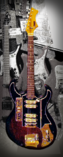
Montclair (1960s)

Ibanez Creative person
(mid 1970s)

Ibanez Iceman
The Hoshino Gakki visitor began in 1908 as the instrument sales division of the Hoshino Shoten, a bookstore concatenation. Hoshino Gakki decided in 1935 to brand Spanish-manner acoustic guitars, at kickoff using the "Ibanez Salvador" brand name in honour of Spanish luthier Salvador Ibáñez, and later simply "Ibanez".[iii] Appropriately, the brand originally was spelled イバニェス in Nihon, reflecting the Castilian pronunciation, before changing its spelling in 1986 to the electric current name, which represents an English language pronunciation of Ibanez.
The modern era of Ibanez guitars began in 1957.[four] The late 1950s and 1960s Ibanez catalogues show guitars with some wild-looking designs,[5] manufactured by Kiso Suzuki Violin,[model 1] Guyatone,[model two] [model three] and their own Tama factory established in 1962.[3] [6] Later the Tama manufactory stopped manufacturing guitars in 1966, Hoshino Gakki used the Teisco[ citation needed ] and FujiGen Gakki guitar factories to brand Ibanez guitars, and after the Teisco String Musical instrument factory airtight in 1969/1970, Hoshino Gakki used the FujiGen Gakki guitar factory to make Ibanez guitars.

Ibanez S

Ibanez RG

Ibanez UV777
In the 1960s, Japanese guitar makers mainly copied American guitar designs, and Ibanez-branded copies of Gibson, Fender, and Rickenbacker models appear. This resulted in the so-called lawsuit period.
Hoshino Gakki introduced Ibanez models that were definitely non copies of the Gibson or Fender designs, such as the Iceman and the Roadstar series. The company has produced its own guitar designs ever since. The late 1980s and early 1990s were an of import period for the Ibanez brand. Hoshino Gakki's human relationship with guitarist Steve Vai resulted in the introduction of the Ibanez JEM and the Ibanez Universe models; afterwards the before successes of the Roadstar and Iceman models in the late 1970s – early 1980s, Hoshino Gakki entered the superstrat market with the RG series, a lower-priced version of their JEM series.


Ibanez AS200

Ibanez EW20ASE (Exotic Wood)
Hoshino Gakki also had semi-acoustic, nylon- and steel-stringed acoustic guitars manufactured under the Ibanez proper noun. Most Ibanez guitars were made past the FujiGen guitar factory in Nihon up until the mid- to belatedly 1980s, and from then on Ibanez guitars have also been made in other Asian countries such equally Korea, China, and Indonesia. During the early 1980s, the FujiGen guitar factory as well produced most of the Roland guitar synthesizers, including the Stratocaster-mode Roland K-505, the twin-humbucker Roland K-202 (endorsed by Adrian Belew, Eric Clapton, Dean Brown, Jeff Baxter, Yannis Spathas, Christoforos Krokidis, Steve Howe, Mike Rutherford, Andy Summers, Neal Schon and Steve Hackett) and the Ibanez X-ING IMG-2010.
Cimar and Starfield were guitar and bass brands endemic by Hoshino Gakki. In the 1970s, Hoshino Gakki and Kanda Shokai shared some guitar designs, and so some Ibanez and Greco guitars have the aforementioned features. The Greco versions were sold in Japan and the Ibanez versions were sold outside Nihon. From 1982, Ibanez guitars have as well been sold in Nihon every bit well.[7]
Guitar brands such as Antoria and Mann shared some Ibanez guitar designs. The Antoria guitar brand was managed by JT Coppock Leeds Ltd England. CSL was a brand name managed by Charles Summerfield Ltd England. Maurice Summerfield of the Charles Summerfield Ltd company contributed some pattern ideas to Hoshino Gakki and also imported Ibanez and CSL guitars into the UK from 1964 to 1987.[4] The Maxxas make proper noun came about considering Hoshino Gakki thought that the guitar did non fit in with the Ibanez model range and was therefore named Maxxas by Rich Lasner from Hoshino U.s..[8]
The "lawsuit" guitars [edit]

Mid-1970s "Lawsuit Era" solid body, Set neck, Mann/Ibanez electric guitar
Harry Rosenbloom, founder of the (now-airtight) Medley Music of Bryn Mawr, Pennsylvania, was manufacturing handmade guitars under the name "Elger". By 1965, Rosenbloom had decided to stop manufacturing guitars and chose to go the exclusive Northward American distributor for Ibanez guitars. In September 1972, Hoshino began a partnership with Elger Guitars to import guitars from Japan. In September 1981, Elger was renamed "Hoshino U.S.A.", retaining the company headquarters in Bensalem, Pennsylvania as a distribution and quality-control center.
On June 28, 1977, in the Philadelphia Federal District Court, a lawsuit was filed by the Norlin Corporation, the parent company of Gibson Guitars, confronting Elger/Hoshino UsA.'southward utilize of the Gibson headstock design and logo. Hoshino settled out of court in early 1978 and the case was officially closed on February 2, 1978.[ix] [10]
Later on the lawsuit, Hoshino Gakki abandoned the strategy of copying "classic" electrical guitar designs, having already introduced a plethora of original designs. Hoshino was producing their original Artist models from 1974, introducing a set-neck model in 1975. In 1977, they upgraded and extended their Artist range and introduced a number of other meridian-quality original designs made to match or surpass famous American brands: the Performer and short-lived Concert ranges, which competed with the Les Paul; through-neck Musicians; Studios in fixed- and through-neck construction; the radically shaped Iceman; and the Roadster which morphed into the Roadstar range, precursor to the popular superstrat era in the mid-1980s. The newer Ibanez models began incorporating more modernistic elements into their design such as radical body shapes, slimmer necks, 2-octave fingerboards, slim pointed headstocks, college-output electronics, humbucker/single-coil/humbucker (H/South/H) pickup configurations, locking tremolo bridges and unlike finishes.
Guitars [edit]
Sub-brands [edit]
- Ibanez J. Custom
- The J. Custom serial are the near exclusive and loftier-finish custom shop guitars Ibanez offers. They are "Envisioned to be the finest Japanese-made guitar in history". Congenital past some of the most skilled luthiers Ibanez has to offering, they "stand for every advance in design and technology Ibanez has developed over the last twenty years". As of 2022, they feature aftermarket pickups of the Dimarzio brand (DiMarzio® Air Norton™, DiMarzio® True Velvet™, DiMarzio® The Tone Zone® and DiMarzio® PAF® 7), 5 piece maple/wenge necks with Titanium reinforcement rods, ebony fingerboard with a tree of life fret board inlay, and Edge Nothing tremolo systems.
- Ibanez Prestige
- The Prestige guitars are Ibanez'south top-of-the-line models that are congenital in Nihon. They characteristic higher quality materials, high craftsmanship, and higher quality bridges compared to other models.
- Ibanez Premium
- The Premium guitars are similar to other models but are built in Ibanez'southward Indonesian premium factory to premium quality standards.
- Ibanez Gio
- The Ibanez Gio are Ibanez' budget guitars, designed for high playability at low costs. Many loftier terminate Ibanez guitars are recreated in the more than affordable Gio form, such as the RGA and Fine art models.
- U.Southward.A. custom
- USA custom range. Late 1980s to mid-1990s. Also known as Ibanez LACS (L.A. Custom Shop), services just their endorsed artists today.[eleven]
Solid body electric guitars [edit]
- Ibanez RG
- The main characteristics that are mutual among all Ibanez RG guitars (RG stands for Roadstar Guitar[model 4] [ verification needed ]) are that they characteristic 24 frets and use thin necks, known as "Magician", which allows for faster playing.[model v] The RG features a line upward of guitars with both floating tremolo systems and fixed bridge systems.

- Ibanez RGA
- The Ibanez RGA was introduced at a fourth dimension when the Ibanez RG serial only had tremolo bridges. Since and then, the RG series has introduced fixed bridge models, but Ibanez nonetheless produces the RGA series with an arched top to differentiate from the RG series. The arched peak allows for added comfort while playing the guitar.[model 6]
- Ibanez RGD
- The Ibanez RGD guitar was developed for heavy metal guitar players.[model vii] The RGD features a 26.5" scale which allows for lower than standard guitar tuning while retaining standard string tension without utilize of thicker estimate strings. It also features an extra deep scoop cut on the lower horn for like shooting fish in a barrel high fret access. Ibanez currently makes 2 Ibanez RGD Prestige models.
- Ibanez Southward
- The Ibanez Southward (Saber[model 8] [ verification needed ]) guitar has an extremely thin body made out of mahogany, and is bachelor in six, 7 and 8-string models. They may come up with either 22 or 24 frets, depending on twelvemonth of manufacture. The standard line currently take Wizard III necks that are slightly wider and thicker than the original Wizard. All S models have bodies that are thicker in the middle where the pickups are, and taper off towards the outer edges. The guitars use ZR (Zero Resistance), Lo-TRS, and variants of the Edge bridge system as well as fixed bridges.[model 8] Ibanez currently makes eight Prestige Southward-Series guitars.
- Ibanez DN
- The Ibanez DN guitar (DN stands for Darkstone[ commendation needed ]) was adult for heavy metal guitar players. The main features of the DN are that it has a ready-in neck for speed and playing comfort, medium frets, and coil tapped pickups. This guitar is currently discontinued.
- Ibanez X
- The Ibanez X guitars are Ibanez guitars that characteristic unconventional and unique body designs. An instance would be the Ibanez Xiphos, which is stylized to look similar the letter of the alphabet 10.[model 9] For all X guitars currently available and for more than data, check the Ibanez Electric Guitar page in 2013. (as of 2013, variations may be: Halberd XH300 and Glaive XG300, Mick Thomson Signature MTM100, MTM10)[ clarification needed ]
- Ibanez Artist (AR)
- The Ibanez Artist guitars were designed for heavy playing such as for heavy metal or traditional stone. The Artist ARZ is a single cutaway, 24 fret, 25" scale guitar that features a wide diversity of bridges and pickups depending on the specific models.[model 10] The Artist ART is a single cutaway, 22 fret, 24.75" calibration guitar that features a difficult tail span.[model 11] [ verification needed ] The Ibanez AR is a reissued serial originating from the 70s. The AR series features a ready-in neck, double cutaway, with 22 frets on a 24.75" scale.[model 12]
- Ibanez FR
- The Ibanez FR is a simple trunk type guitar that is designed to be played in many genres.[model 13]
- Ibanez Mikro
- The Ibanez Mikro series are minor form cistron[ when defined as? ] guitars designed for children, beginners, or guitar players looking for a guitar that is easy to transport.[model 14]
Hollow body electric guitars [edit]
- Ibanez Artcore serial
- The first Ibanez Artcore models were released in mid-2002 whose goal was to offer an affordable range of full-hollow and semi-hollow body guitars that appealed to entry level guitarists who were unable or unwilling to pay big money on high-priced guitars.
- Ibanez Artcore Custom
- The Artcore Custom is Ibanez's flagship model for the Artcore series. The bodies of the guitars are made of maple, the cervix has a set-in construction type, and features wood control knobs and mitt rolled frets.[model 15]

Headstock from an ARTCORE series guitar
- Ibanez AK
- The Ibanez AK is a guitar designed for jazz and dejection type playing. It features a slim prepare-in neck with a body designed to hands admission the higher frets.[model 16] The AK is easily distinguishable by its sharper lower torso horn (Florentine cutaway ?) that other Artcore guitars do not accept.[ clarification needed ]
Product signature guitars [edit]


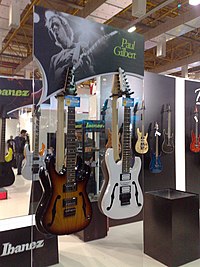
- JEM , Universe and Pia Series – Steve Vai Signature
- JS – Joe Satriani Signature
- PGM – Paul Gilbert Signature
- APEX – Munky Signature
- Due east-Gen – Herman Li Signature
- NDM4 – Noodles Signature
- PWM - Paul Waggoner Signature
- KIKO - Kiko Loureiro Signature
- STM2 – Sam Totman Signature
- ORM – Omar Rodriguez Signature
- MBM – Matt Bachand Signature
- HRG – H. R. Giger Signature
- GB – George Benson Signature
- K7 – Head and Munky Signature
- PM – Pat Metheny Signature
- PS10 – Paul Stanley Signature[12]
- JSM – John Scofield Signature
- AT – Andy Timmons Signature
- TAM - Tosin Abasi Signature
- RBM - Reb Embankment Signature
- JBM - Jake Bowen Signature
- BBM - Ben Bruce Signature
- JIVA - Nita Strauss Signature
- THBB - Tim Henson Signature
- SLM - Scott LePage Signature
- MAR - Mario Camarena Signature
- EH - Erick Hansel Signature
- YY - Yvette Immature Signature
- M8M - Mårten Hagström Signature
- FTM - Fredrik Thordendal Signature
- ICHI - Ichika Nito Signature
- LB - Lari Basilio Signature
Discontinued guitars [edit]
Discontinued guitars
- Ibanez R series, also known as the Radius serial, are famous for having lightweight aerofoil-profiled basswood bodies. The primary endorser was Joe Satriani before he was given his own Signature JS serial. The Radius series is now discontinued.
- RT series – Superstrat design with 24 frets. Discontinued in 1994.
- RX series – Superstrat design just with 22 frets instead. Discontinued in 1998, and currently only exists equally GRX (upkeep model of RX series).
- Axstar (a.k.a. Axstar past Ibanez) – discontinued
- EDR/EXR – Ergodyne series – discontinued
- MC – Musician series – Discontinued – Neck-through construction (except for MC-100, which has a commodities-on cervix), with 24 frets (ii octaves) – Every bit with the Artist models of the late 1970s, some of these guitars were equipped with trisound switches, and some models (MC 400 and MC 500) were equipped with agile electronics.
- ST – Studio series 1977–82 offset double cutaway ranging from commodities on to stock-still and through necks with pairs of V2 distortion humbuckers. 24 frets and 25.5" scale.
- CN – Concert range 1977–79 like a bolt on neck Artist with slightly offset cutaways.
- IC – Iceman a radical shape endorsed and used by Paul Stanley, Various pickup combinations.
- SB70 – Studio & Blazer spot build: Mixing Studio series double cutaway, ash bodies with Blazer series 21 fret commodities on maple necks, and sporting a stock-still brass bridge, 2 Super 70 Humbuckers, i vol, 2 tone knobs, a pickup selector switch, and a stage mini-toggle switch (which gives a unique strat-like dishonest audio), an estimated 300-400 of these were assembled, mostly in 1982. A cult following has emerged, as these guitars are rare, and sell for 3x-4x their original price. Learn more at The Unofficial SB70 Registry: https://www.ibanezcollectors.com/forum/index.php?topic=20623.0
- BL – Blazer serial 1980–82 – fixed bridge strat-like with maple necks and mahogany or ash bodies sporting 3 unmarried coil pickups (Super 6 or BL) or 2 Super lxx humbuckers.
- ARC-100/300 (Retro Serial)
- ARX-100/300 (Retro Serial)
- AR-100/200 (black vintage top)
- V Series – Flying V's – discontinued
- Ibanez Artcore Serial – Ibanez'south full and semi-hollow guitar line, with some models discontinued since their debut in 2002.
- Ibanez Jet King 2 and Jet Male monarch ane – A modern remake of the Ibanez Rhythm maker, vintage looking and sounding guitars.
- Radius serial – discontinued, a modified version is now taken over by the Joe Satriani signature series which features a multi-radius neck.
- EX Series – Manufactured in Korea and Nihon (rare).
- PL – Pro Line series
- RR – Rocket Scroll
- DT – Destroyer
- IC – Iceman
- Talman Serial – discontinued
- CN Concert Series – This was a brusk lived serial produced in 1978 then discontinued soon afterwards. It features an disproportionate double cutaway body with two humbuckers, a hard tail span and a bolt on neck. The meridian terminate model (the CN250) was 1 of the earliest guitars to characteristic "half vine" fingerboard inlays.
- Power II series (540PII) - extended length lower cutaway, wide (1 3/4")nut,available in H-H or H-S with border trem. Often erroneously assumed to exist an Alex Skolnick signature model due to his picture in the 88-89 catalogue with a 540PII. Primarily released for the Japanese market, although it has the Bensalem Penn. neck plate.
- AFD – Artfield
- GR – Ghostrider series, arched-top double cutaway design. 24 3⁄four " scale length. Most notably played by Shawn Lane.
- Cimar by Ibanez
Bass guitar models [edit]
- SR (Soundgear) Series
- Center-class model range in the new millennium, though it included expensive high-finish and top-of-the-line Japanese models in the tardily 1980s and 1990s. Later meridian offerings were branded equally Signature and SR Prestige models for clearer segmentation, and all non-Prestige model production moved exterior Japan. Current models from the SR250 and up feature soapbar-way humbuckers with agile EQ.
- SR Prestige
- Loftier-stop versions of the Ibanez Soundgear (SR-5004/v/6 & SR-4004/5/6) Bass Guitars made in Japan using exotic woods and high-quality custom Bartolini pickups & new "PWC-Three" Power Curve III 3-band EQ with EQ bypass switch to featherbed the electronics and take the bass point directly from the pickups to the output jack. All Japanese-built electric current production models are in the Prestige serial.
- SR Premium
- Nordstrand pickups. Indonesian-congenital.
- AFFIRMA series - solidbody basses designed past Rolf Spuler and made in Nippon
- AFR - set neck, one magnetic pickup, and a piezo span
- Original series was launched in the early 1990's, a reissue series was released 2020
- ARTCORE Series- Archtop Basses
- Artist (Model 2626B - Carved-pinnacle solid-body set-cervix bass, twin humbuckers, fabricated late Seventies.)
- AFB200 – Hollow-body bass guitar
- AGB200 – Semihollow-body bass guitar
- ATK Series
- ATK 300 iv string model
- ATK 305 v string model
- ATK 1200, the Prestige version of the standard ATK, has actress cervix pickup
- ATK 800E, to exist released in 2012, a Premium version of the standard ATK. Has extra neck pickup
- ATK 805E, to be released in 2012, a Premium version of the standard ATK. Has extra neck pickup, 5-cord model
- Blazer
- BTB (Bazaar Bass) Series
- BTB 400QM (discontinued)
- BTB 406QM (Special Edition half-dozen Cord Model)
- BTB Prestige – High-end range which are made in Japan.
- Ergodyne Serial - Bodies made from Luthite polymer.
- EDA Series
- EDB Series
- EDC Series
- EWB Serial
- GARTB xx
- GATK 20 – More affordable version of the ATK.
- GAXB Serial (discontinued)
- GSR Series- A lower-toll version of the Soundgear Series
- GSR 100 – The original GSR bass guitar (Discontinued)
- GSR 100 EX
- GSR 105 EX
- GSR 180
- GSRM xx
- GSR 250 M
- GSR 200
- GSR 200 FM – The GSR but with unlike color designs such every bit sunburst.
- GSR 205 – Nominated for Ibanez's "All-time of Model" award
- GSR 205 FM
- ICB (Iceman) Series
- JTK (Jet Rex) Series
- JUMPSTART Series- Like to the GSR Series, named for the Jumpstart Pack which comes with amp and other accessories.
- Musician Series
- ROADGEAR Series
- SRX (Soundgear) Series
- EX series
- Roadstar Series
- S series
- STUDIO series - Late Seventies bolt-on cervix alternative to the Musician series. Included an 8-cord bass.
- TR Series
Signature basses [edit]
- K5 Fieldy
- A custom 5-string Soundgear design w/ "K5" Inlay centered on 12th fret. It was based around a tardily-1990s then-summit-of-the-line Soundgear SR885 endemic by the artist, retaining the shape and electronics, simply with dissimilar colour options and a alter of woods to arrange his preferences. Early models were Japanese-built, but production later moved to other Asian countries, around the same time Japanese models were rebranded with the Prestige moniker and positioned every bit the absolute acme of the line.
- SDB – Sharlee D'Angelo Signature bass
- PRB – Paul Romanko Signature bass
- GWB – Gary Willis Signature bass
- MDB – Mike D'Antonio Signature bass
- DTB – Dionald Tubang Signature bass
- GVB - Gerald Veasley Signature bass
- VWB1 – Verdine White Signature bass (discontinued)
- PGB - Paul Greyness Signature and Tribute bass (discontinued)
- DWB - Doug Wimbish Series
Audio-visual guitar models [edit]
- AE Serial
- AE5LG
- AEL Serial
- AES Series
- DT Series
- EP9 Serial
- EW Series
- GA Serial
- JAMPACK Serial
- MANDOLIN Series
- MANN Serial (Canadian distribution just)
- MASA Series
- PF Series
- PC serial
- TALMAN Serial
- V Series
- Concur
- SAGE Series
- A300AVV audio-visual/electric single cutaway (Ambiance series)
Amplifiers [edit]
Guitar amplifiers [edit]
- Iron Characterization
- IBZ
- IBZ15GR
- IBZ10G
- TBX Tone Blaster Series
- TSA
- TSA15/TSA15H
- TSA30/TSA30H
Bass amplifiers [edit]
- Promethean
- IBZ
- Sound Moving ridge
Acoustic amplifiers [edit]
- Troubadour
Upshot pedals [edit]


Ibanez DE7 Delay/Repeat Pedal
In the 1970s, the Nisshin Onpa company who owned the Maxon brand name, developed and began selling a serial of effect pedals in Japan. Hoshino Gakki licensed these for sale using the proper noun Ibanez exterior Nippon. These two companies somewhen began doing less and less business together until Nisshin Onpa ceased manufacturing the TS-9 reissue for Hoshino Gakki in 2002.
*ToneLok Series
-
- AP7 Analog Phaser
- AW7 Autowah
- CF7 Stereo Chorus/Flanger
- DE7 Stereo Delay/Echo
- DS7 Baloney
- FZ7 Fuzz
- LF7 Lo-Fi
- PD7 Phat Hed Bass Overdrive
- SB7 Synthesizer Bass
- SH7 Seventh Heaven
- SM7 Smashbox
- TC7 Tri Mode Chorus
- TS7 Tube Screamer
- WD7 Weeping Demon
- WD7JR Weeping Demon Junior
- viii Serial
- Advert-lxxx Analog Delay 1979-1981
- TS808 Tube Screamer 1979 - 1981
- 9 series
- AD9 Analog Filibuster
- AF9 Machine Filter
- BB9 Bottom Booster
- BC9 Bi-Mode Chorus
- CP9 Compressor/Limiter
- CS9 Stereo Chorus
- FL9 Flanger
- GE9 Graphic EQ
- JD9 Jet Driver
- OD9 Overdrive
- PQ9 Parametric EQ
- PT9 Phaser
- SD9 Sonic Baloney
- SM9 Super Metal
- ST9 Super Tube Screamer
- TS9 Tube Screamer
- TS9B Bass Tube Screamer
- TS9DX Turbo Tube Screamer
- TS930TH 30th Anniversary Tube Screamer
- Wah Pedals
- WD7
- WH10V2
Ibanez endorsers: past and present [edit]
Serial numbers [edit]
| Series numbers |
|---|
| Ibanez Serial Numbers (not Audio-visual) Japanese Ibanez Series Numbers 1997 and after (CE logo designation)
1987-1997
1975-1986
Virtually Ibanez models with this serial number format were made by FujiGen Gakki. Exceptions are the Ibanez Blazer models which were made by Dyna Gakki and the Axstar past Ibanez models AX40, AX45, AX48, AXB50, AXB60, AXB65, AX70, AX75 which were fabricated by Chushin Gakki. The Ibanez Axstar AXB1000 model was fabricated past FujiGen Gakki.[4] Korean Ibanez Series Numbers C = Cor-Tek (Cort), S = Samick(1990–1995), South/SQ = Saehan(Sunghan), P = Peerless (Iida), Y = Yoojin, A = Sae-In.
E = Sung-Eum
W = World
Indonesian Ibanez Serial Numbers I = Cor-Tek (Cort) Indonesia, K = KWO
Chinese Ibanez Series Numbers Z = Yeou Chern, J=Sejung
Odd Ibanez Serial Numbers
Older Acoustic
Silverish Buck model
Pickup Serial Numbers |
References [edit]
- ^ LTD., HOSHINO GAKKI CO. "Ibanez guitars". Retrieved 2017-05-17 .
- ^ "Ibanez at AMS". American Musical Supply . Retrieved 2017-06-20 .
- ^ a b "Hoshino Gakki History". HoshinoGakki.co.jp.
- ^ a b c Ibanez: The Untold Story 2005
- ^ "Vintage Ibanez Guitar Site – 1960's Models, Early Imports". VintageIbanez.tripod.com . Retrieved 2012-01-12 .
- ^ "富士弦楽器とIbanez" [FujiGen and Ibanez]. Matsumoto GUITARS [Guitar manufacturers in Matsumoto City] (in Japanese). Matsumoto: Junk Guitar Museum. Archived from the original on 2013-10-05. Retrieved 2013-06-16 .
- ^ Rainer Daeschler. "Fujigen Gakki – From the Cowshed to the Top". Daeschler.com . Retrieved 2012-01-12 . (based on Frg version on stratomaniac.com); Originally published equally "Fujigen vom Kuhstall zur Weltspitze". Fachblatt Musikmagazin. 1987 (two).
- ^ "Rich Lasner, Designer & Creative person Relations, USA 1984–1989". (interview), Nuno – The Ibanez Interviews, IbanezRegister.com (1984-12-04). Archived from the original on 2012-03-09. Retrieved 2012-01-12 .
- ^ Zachary R. Fjestad (2008). Blue Book of Acoustic Guitars. Alfred Music Publishing. p. 331. ISBN978-one-886768-74-one.
- ^ "A Brief History of Ibanez Guitars: From Importer to Industry Leader". reverb.com . Retrieved 2017-05-17 .
- ^ "USA Custom Shop". world wide web.jemsite.com . Retrieved 17 March 2018.
- ^ "Paul Stanley Guitars". Paul Stanley. Retrieved 2017-08-07 .
- Models
- ^ Star Musical Merchandise Itemize No.591, Nagoya, Nihon: Hoshino Gakki Ten, Inc., 1950s, archived from the original on 2011-08-20, retrieved 2015-05-17 .
Note: the wide multifariousness of musical instruments in this catalog reflect their full-time export business during that era. The arched-top guitars and violin-family instruments propose the interest of Suzuki Violin in Nagoya and its blood brother mill, Kiso Suzuki Violin in Kiso. Their tertiary brother in Matsumoto, Shin'ichi Suzuki was a founder of the Suzuki method, and their cultural activities influenced the establishment of FujiGen in Matsumoto, according to a co-founder of FujiGen, Yuichiro Yokouchi Archived 2013-01-xvi at the Wayback Automobile. - ^ 1960 Star Catalog, p. iv, archived from the original on 2011-08-20, retrieved 2015-05-17 (Models: EG 80, EG 80-B, EG 80-H, EG 90)
- ^ 1961 Ibanez Electric Guitars, p. 1, 2, archived from the original on 2011-08-20, retrieved 2015-05-17 (Models: No. 1830 (2pu), No. 1850 (3pu), No. 1860 (2pu with tremolo), No. 1880 (3pu with tremolo), No. 1950 (bass))
- ^ "Ibanez RG3550MZ". 2013. Archived from the original on 2013-08-01.
- ^ "Ibanez RG Serial". Ibanez.co.jp. 2015. Archived from the original on 2015-09-08. Retrieved 2015-05-sixteen .
Atomic number 26 LABEL ... For the ultimate in playability nosotros took our legendary super-sparse, ultra-playable Wizard cervix, and upped the dues to Nitro Wizard - as fast and comfortable merely with added road-tested durability. ...
- ^ "Ibanez RGA8". 2013. Archived from the original on 2013-06-03.
Add 3-D curves to the concept of the RG and you've got the RGA. ...those curves enhance playability. ...
- ^ "Ibanez RGD2127Z Prestige". 2015. Archived from the original on 2015-04-23. Retrieved 2015-05-xvi .
The RGD is Ibanez's ultimate metal machine.
- ^ a b "Ibanez S Series". Ibanez.co.jp. 2013. Archived from the original on 2013-08-12.
- ^ "Ibanez Xiphos Serial". Ibanez.co.jp. 2015. Archived from the original on 2015-06-10. Retrieved 2015-05-16 .
- ^ "Ibanez ARZ6UC Prestige". 2015. Archived from the original on 2015-05-27. Retrieved 2015-05-16 .
The 24 fret, two-octave fretboard of the ARZ surpasses the boundaries of traditional single-cutaway guitars. ... Scale: 638mm/25.i"
- ^ "Ibanez Fine art Series". Ibanez.co.jp. 2013. Archived from the original on 2013-07-04.
- ^ "Ibanez AR720FM". 2015. Archived from the original on 2015-05-23. Retrieved 2015-05-sixteen .
The AR is a classic among Ibanez guitars. It was one of the first original designs produced past Ibanez and continues to be a sought afterwards guitar. The AR series continues that legacy with pride. ... Gear up-in neck: AR720FM features shine heel for superb playability. ... Scale: 628mm/24.75"
- ^ "Ibanez FR Serial". Ibanez.co.jp. 2015. Archived from the original on 2015-09-09. Retrieved 2015-05-16 .
FR Standard - With its simple, refined body shape, the FR is a chameleon when it comes to musical genres. The Ibanez CCR pickups bring more than punch to the midrange tones while the Tight-End bridge provides maximum sustain and playing comfort.
- ^ "Ibanez miKro GRGM21". Archived from the original on 2015-05-27. Retrieved 2015-05-16 .
GRG miKro puts out sound way beyond its size. Perfect for immature rockers on the way up or seasoned road warriors on the tour double-decker. ... Scale : 564mm/22.2"
- ^ "Ibanez Artcore Custom". Ibanez.com. 2013. Archived from the original on 2013-01-19.
The Artcore Custom is the flagship of the Artcore series, featuring beautiful maple bodies and maple/walnut gear up-in neck structure, producing a warm yet punchy tone. Wood control knobs and matching pickguard heighten the exquisite appearance of the Artcore Custom. ... Hand-rolled frets for ultimate playablity
- ^ "Ibanez AK95". Ibanez.com. 2012. Archived from the original on 2012-10-22.
Jazz and blues history is filled with the warm tones of full-hollow body guitars. The AK is the answer to those who loves traditional sweetness tones and easy accessibility to higher frets. ... Slim & comfortable iii-pc Artocre ready-in cervix
- Bibliography
- Acoustic Guitars: The Illustrated Encyclopedia. New York: Chartwell Books. 2011. ISBN978-0-7858-3571-4.
- "Ibanez Catalogs". (catalog annal), Ibanez.co.jp. 2015.
Search Catalogs: 1950s, 1960s, 1970s, 1980s, 1990s, 2000s, 2010s
- Paul Specht; Michael Wright; Jim Donahue (2005). Ibanez: The Untold Story. Hoshino (U.s.A.) Inc. ISBN0-9764277-0-2.
External links [edit]
 | Wikimedia Commons has media related to Ibanez. |
- Official website

Source: https://en.wikipedia.org/wiki/Ibanez

Posting Komentar untuk "Replacing Art 1 Quick Change Bridge on an Ibanez Arz200"