Post Apocalyptic Mob Art Mob of People Concept Art
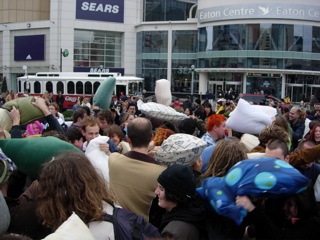
A wink mob (or flashmob)[one] is a grouping of people who assemble all of a sudden in a public place, perform for a brief fourth dimension, then quickly disperse, often for the purposes of entertainment, satire, and artistic expression.[two] [3] [four] Flash mobs may be organized via telecommunications, social media, or viral emails.[5] [6] [7] [8] [9]
The term, coined in 2003, is generally not practical to events and performances organized for the purposes of politics (such as protests), commercial advert, publicity stunts that involve public relation firms, or paid professionals.[7] [10] [11] In these cases of a planned purpose for the social activeness in question, the term smart mobs is oft applied instead.
The term "wink rob" or "wink mob robberies", a reference to the style flash mobs assemble, has been used to describe a number of robberies and assaults perpetrated suddenly past groups of teenage youth.[12] [thirteen] [fourteen] Bill Wasik, originator of the first flash mobs, and a number of other commentators have questioned or objected to the usage of "flash mob" to describe criminal acts.[14] [15] Flash mob has also been featured in some Hollywood picture show serial, such every bit Pace Up.[16]
History [edit]
First flash mob [edit]

Flash mobbing was quickly imitated exterior of the U.s.a.. This picture is of "sydmob" 2003, the starting time flashmob held in Sydney, Australia
The first flash mobs were created in Manhattan in 2003, past Bill Wasik, senior editor of Harper's Magazine.[7] [9] [17] The first attempt was unsuccessful after the targeted retail store was tipped off well-nigh the plan for people to gather.[xviii] Wasik avoided such problems during the first successful wink mob, which occurred on June 17, 2003, at Macy's department store, past sending participants to preliminary staging areas—in four Manhattan bars—where they received further instructions about the ultimate event and location simply before the event began.[19]
More than than 130 people converged upon the ninth floor rug department of the store, gathering effectually an expensive rug. Anyone approached by a sales assistant was advised to say that the gatherers lived together in a warehouse on the outskirts of New York, that they were shopping for a "honey rug", and that they fabricated all their buy decisions every bit a group.[twenty] Afterwards, 200 people flooded the antechamber and mezzanine of the Hyatt hotel in synchronized applause for about xv seconds, and a shoe boutique in SoHo was invaded by participants pretending to be tourists on a autobus trip.[9]
Wasik claimed that he created wink mobs as a social experiment designed to poke fun at hipsters and to highlight the cultural temper of conformity and of wanting to be an insider or office of "the next big affair".[9] The Vancouver Sun wrote, "Information technology may accept backfired on him ... [Wasik] may instead take ended upwardly giving conformity a vehicle that allowed it to appear nonconforming."[21] In another interview he said "the mobs started every bit a kind of playful social experiment meant to encourage spontaneity and large gatherings to temporarily take over commercial and public areas simply to bear witness that they could".[22]
Precedents and precursors [edit]
In 19th-century Tasmania, the term flash mob was used to depict a subculture consisting of female prisoners, based on the term wink linguistic communication for the jargon that these women used. The 19th-century Australian term flash mob referred to a segment of society, not an event, and showed no other similarities to the modern term flash mob or the events it describes.[23]
In 1973, the story "Flash Crowd" past Larry Niven described a concept similar to wink mobs.[24] With the invention of popular and very cheap teleportation, an argument at a shopping mall—which happens to be covered by a news crew—speedily swells into a riot. In the story, broadcast coverage attracts the attention of other people, who apply the widely available technology of the teleportation berth to swarm start that consequence—thus intensifying the riot—and so other events as they happen. Commenting on the social impact of such mobs, one character (articulating the police view) says, "We telephone call them wink crowds, and we watch for them." In related brusk stories, they are named as a prime location for illegal activities (such equally pickpocketing and looting) to have place. Lev Grossman suggests that the story title is a source of the term "flash mob".[25]
Flash mobs began every bit a grade of performance art.[eighteen] While they started equally an apolitical act, flash mobs may share superficial similarities to political demonstrations. In the 1960s, groups such as the Yippies used street theatre to betrayal the public to political bug.[26] Wink mobs tin can exist seen equally a specialized form of smart mob,[7] a term and concept proposed past author Howard Rheingold in his 2002 book Smart Mobs: The Adjacent Social Revolution.[27]
Employ of the term [edit]
The starting time documented use of the term wink mob as it is understood today was in 2003 in a blog entry posted in the backwash of Wasik's event.[17] [19] [28] The term was inspired by the earlier term smart mob.[29]
Flash mob was added to the 11th edition of the Concise Oxford English Dictionary on July viii, 2004, where information technology noted information technology as an "unusual and pointless act" separating it from other forms of smart mobs such as types of performance, protests, and other gatherings.[3] [30] Also recognized noun derivatives are flash mobber and flash mobbing.[three] Webster'southward New Millennium Dictionary of English defines wink mob as "a group of people who organize on the Internet and then quickly get together in a public place, exercise something bizarre, and disperse."[31] This definition is consequent with the original apply of the term; however, both news media and promoters have afterward used the term to refer to any form of smart mob, including political protests;[32] a collaborative Internet denial of service set on;[33] a collaborative supercomputing demonstration;[34] and promotional appearances by pop musicians.[35] The printing has also used the term flash mob to refer to a exercise in China where groups of shoppers arrange online to encounter at a shop in order to drive a collective deal.[36]
Legality [edit]
The metropolis of Brunswick, Federal republic of germany has stopped flash mobs past strictly enforcing the already existing law of requiring a permit to use any public space for an event.[37] In the United Kingdom, a number of wink mobs have been stopped over concerns for public health and prophylactic.[38] The British Send Police have urged flash mob organizers to "refrain from holding such events at railway stations".[39]
Offense [edit]
Referred to as wink robs, flash mob robberies, or flash robberies by the media, crimes organized by teenage youth using social media rose to international notoriety beginning in 2011.[12] [13] [xiv] [40] The National Retail Federation does not allocate these crimes as "flash mobs" but rather "multiple offender crimes" that utilize "flash mob tactics".[41] [42] In a report, the NRF noted, "multiple offender crimes tend to involve groups or gangs of juveniles who already know each other, which does non earn them the term 'wink mob'."[42] Mark Leary, a professor of psychology and neuroscience at Knuckles University, said that nigh "flash mob thuggery" involves crimes of violence that are otherwise ordinary, but are perpetrated suddenly past large, organized groups of people: "What social media adds is the ability to recruit such a big group of people, that individuals who would not rob a store or riot on their own feel freer to misbehave without existence identified."[43]
It'southward difficult for me to believe that these kids saw some YouTube video of people Christmas caroling in a food court, and said, 'Hey, we should do that, except as a robbery!' More than likely, they stumbled on the simple realization (like I did back in 2003, but like lots of other people had earlier and have since) that 1 consequence of all this technology is that yous tin coordinate a ton of people to show up in the same identify at the same time.
—Neb Wasik[44]
These kids are taking part in what's basically a meme. They heard about it from friends, and probably saw it on YouTube, and now they're getting their adventure to participate in it themselves.
—Bill Wasik[14]
HuffPost raised the question asking if "the media was responsible for stirring things upwards", and added that in some cases the local authorities did not confirm the utilize of social media making the "use of the term flash mob questionable".[15] Amanda Walgrove wrote that criminals involved in such activities don't refer to themselves as "flash mobs", only that this use of the term is withal appropriate.[44] Dr. Linda Kiltz drew similar parallels between flash robs and the Occupy Movement stating, "As the employ of social media increases, the potential for more flash mobs that are used for political protest and for criminal purposes is likely to increase.".[45]
See also [edit]
- Disquisitional mass
- Crowd manipulation
- Happening
- Improv Everywhere
- Zap
References [edit]
- ^ "Facebook flashmob shuts downwardly station". CNN. February nine, 2009.
- ^ "Va-va-voom is in the dictionary". BBC. July 8, 2004. Retrieved May v, 2010.
- ^ a b c "definition of flash mob from Oxford English Dictionaries Online". Oxford Academy Press. July 8, 2004. Retrieved May nine, 2010.
- ^ "Mixed feelings over Philadelphia's flash-mob curfew". BBC. August 12, 2011.
- ^ Athavaley, Anjali (April xv, 2008). "Students Unleash A Pillow Fight On Manhattan". Wall Street Journal. Archived from the original on Jan xi, 2009. Retrieved May 19, 2008.
- ^ Fitzgerald, Sean D. (March 21, 2008). "International Pillow Fight Solar day: Allow the feathers wing!". National Post. Canada. Retrieved May nineteen, 2008. [ permanent expressionless link ]
- ^ a b c d Judith A. Nicholson. "Flash! Mobs in the Age of Mobile Connectivity". Fibreculture Publications/Open Humanities Press. Archived from the original on Dec 2, 2010. Retrieved July 15, 2009.
- ^ "Fourth dimension Freezes in Central London". ABC News. April thirty, 2008. Retrieved Jan 25, 2009.
- ^ a b c d Sandra Shmueli (August eight, 2003). "'Flash mob' craze spreads". CNN.
- ^ "Manifestul Aglomerarilor Spontane / A Flashmob Manifesto". Dec v, 2004. Archived from the original on February 9, 2007. Retrieved Dec 27, 2011.
- ^ Ed Fletcher (December 23, 2010). "Failed choral 'flash mob' may not have qualified for term". Toronto Star . Retrieved Dec 30, 2010.
- ^ a b Annie Vaughan (June 18, 2011). "Teenage Wink Mob Robberies on the Rise". Flim-flam News. Retrieved June 18, 2014.
- ^ a b Erin Skarda (May 12, 2011). "Flash Mobs Turned Criminal: The Rise of Wink Robberies". Fourth dimension . Retrieved June xviii, 2014.
- ^ a b c d Pecker Wasik (November 11, 2011). "'Flash Robs': Trying to Stop a Meme Gone Incorrect". Wired . Retrieved June 19, 2014.
- ^ a b "'Flash Mob' Attacks Used Past Gun Rights Advocates To Build Concealed Behave Support". The Huffington Postal service. August 8, 2011. Retrieved June 17, 2014.
- ^ "'Step Upwards Revolution' Director, Choreographers Talk Wink Mob Attraction and Former Martial Artist Ryan Guzman's Debut". The Hollywood Reporter. July 26, 2012. Retrieved May 25, 2020.
- ^ a b Wasik, Bill (Jan 2012). "#Riot: Self-Organized, Hyper-Networked Revolts—Coming to a City Nigh You". Wired . Retrieved January 22, 2012.
- ^ a b Goldstein, Lauren (Baronial 10, 2003). "The Mob Rules". Time. Vol. 162, no. 7 - April xviii, 2003. ISSN 0040-781X. OCLC 1767509. Retrieved May 8, 2021.
- ^ a b Wasik, Beak (March 2006). "My Oversupply, or, Phase v: A report from the inventor of the flash mob" (Subscription). Harper's Magazine. March 2006: 56–66. ISSN 0017-789X. OCLC 4532730. Retrieved February 2, 2007.
- ^ Bedell, Doug. "Due east-mail Communication Facilitates New 'Flash Mob' Miracle", Knight Ridder Tribune Concern News, July 23, (2003)
- ^ McMartin, Pete (July 12, 2008). "Waterfight in Stanley Park, but are flash mobs starting to lose their edge?". Canwest Publishing Inc. Archived from the original on July xiv, 2008. Retrieved July 14, 2008.
- ^ Ian Urbina (March 24, 2010). "Mobs Are Born as Word Grows by Text Message". The New York Times . Retrieved December thirty, 2010.
- ^ "The Wink Mob". Cascades Female person Manufactory Historic Site. Female Manufacturing plant Historic Site Ltd. Archived from the original on October half-dozen, 2007. Retrieved October 23, 2007.
- ^ Nold, Christian (2003). "Legible Mob". p. 23.
- ^ Grossman, Lev, (June 13, 2012). "Lord of the Ringworld: In Praise of Larry Niven". Fourth dimension.
- ^ Cosmic Trigger Three, Robert Anton Wilson, 1995, New Falcon Publications
- ^ Chris Taylor (March 3, 2003). "Solar day of the smart mobs". CNN.
- ^ Kara Bloomgarden-Smoke (June 10, 2014). "The New York Times Magazine Names Bill Wasik Deputy Editor". The New York Observer . Retrieved Jan 17, 2016.
- ^ McFedries, Paul (July 14, 2003). "flash mob". WordSpy.com. Logophilia Limited. Retrieved March 14, 2006.
- ^ "Henry inspires English dictionary". BBC. July 8, 2004. Retrieved May ix, 2010.
- ^ "flash mob". Webster'southward New Millennium Dictionary of English, Preview Edition (v 0.nine.6) . Retrieved April 27, 2007.
- ^ "Putin protestation by flash mob". BBC News. February 28, 2004. Retrieved May 3, 2007.
- ^ Musil, Steven (February 11, 2005). "This calendar week in Web threats: The Internet is always good for a petty fear and loathing". CNET News. CNET. Retrieved May three, 2007.
- ^ Biever, Celeste (March 29, 2004). "A Flash mob to attempt supercomputing feat". New Scientist. ISSN 0262-4079. OCLC 2378350.
- ^ Gardner, Elysa (February 27, 2004). "Avril Lavigne, in the flesh, at 'wink mob' appearances". U.s.a. Today. Archived from the original on Oct 14, 2007. Retrieved September 22, 2021.
- ^ "Mainland china's new shopping craze: 'Squad ownership'". Christian Science Monitor. December 5, 2007. Archived from the original on July 14, 2011. Retrieved February 12, 2008.
- ^ "Flash mobs banned in Braunschweig". The Local Europe. July 28, 2009. Retrieved Dec 30, 2010.
- ^ Robert Leigh (May nineteen, 2008). "Videos: Police step in to prevent Facebook flash mob events". Daily Mirror . Retrieved December xxx, 2010.
- ^ "Track police criticise flash mobs". BBC News. February 26, 2009. Retrieved December 30, 2010.
- ^ Daniel Denvir (September 26, 2011). "Are Trigger-happy 'Wink Mobs' Really a Tendency?". CityLab. Retrieved June xviii, 2014.
- ^ Jeffrey Ian Ross (2013). Encyclopedia of Street Crime in America. Sage Publications. ISBN978-1412999571 . Retrieved June 18, 2014.
- ^ a b "Multiple Offender Crimes" (PDF). National Retail Federation. 2011. Archived from the original (PDF) on July xiv, 2014. Retrieved June 19, 2014.
- ^ Leary, Mark. "Why People Take Part in Violent Wink Mobs". Duke University News and Communications. Retrieved September vi, 2011.
- ^ a b Amanda Walgrove (June 20, 2011). "Who Put the 'Flash Mob' in Wink Mob Robberies?". The Faster Times. Archived from the original on September three, 2014. Retrieved June 18, 2014.
- ^ Linda Kiltz. "Flash Mobs: The Newest Threat to Local Governments". Public Management Mag. No. December 2011. Archived from the original on August 26, 2014. Retrieved June xviii, 2014.
Farther reading [edit]
- Agar, Jon (2003). Constant Touch: A Global History of the Mobile Phone. Cambridge: Icon. ISBN9781840464191. OCLC 633650620.
- "Smart mob storms London". BBC News. August 8, 2003. Retrieved September 22, 2021.
- Carey, James (1989). Communication as Culture: Essays on Media and Society. New York: Unwin Hyman. ISBN9780044450641. OCLC 863091901.
- Dickey, Christopher (March 22, 2004). "From nine/11 to 3/eleven". Newsweek. pp. 27–28. Archived from the original on March 14, 2004. Retrieved September 22, 2021.
- Losowsky, Andrew (March 25, 2004). "A 21st Century Protestation". The Guardian. London. Retrieved October 3, 2010.
- Melloan, George (August 12, 2003). "Whoever Said August Was a Boring Month?". The Wall Street Journal. pp. A13. Retrieved September 22, 2021.
- Shmueli, Sandra (August 8, 2003). "Flash Mob Craze Spreads". Applied science. CNN. Retrieved Baronial 11, 2009.
- "Dadaist Lunacy or the Futurity of Protest?". Social Issues Enquiry Centre. Retrieved December 23, 2013.
- Wasik, Bill. "My Crowd". Harper'southward Magazine. No. March 2006. Retrieved June xviii, 2014.
External links [edit]
 | Look up Wink mob in Wiktionary, the free dictionary. |
-
 Media related to Wink mobs at Wikimedia Commons
Source: https://en.wikipedia.org/wiki/Flash_mob

Posting Komentar untuk "Post Apocalyptic Mob Art Mob of People Concept Art"